
The automotive industry is an extremely competitive and rapidly changing business that requires precision, efficiency, and an unrelenting quest for quality. At the center of this dynamic arena stands the position of the quality engineer in automotive industry. Working closely with operators, engineers, and management, these individuals are responsible for providing the necessary assurance that vehicles are meeting tight safety and quality specifications, assisting manufacturers in lowering costs, ensuring customer satisfaction, and meeting regulatory compliance.
If you’ve been wondering what it takes to become a quality engineer in the automotive sector, or you’re looking for information regarding automotive quality control and inspection services in Michigan, this guide is for you.
What is a Quality Engineer in Automotive Industry?
Quality engineering is a discipline that specializes in ensuring products or services adhere to a set of quality standards. It is a fundamental aspect of manufacturing, production, and other sectors where quality control is paramount. Quality engineers ensure that business processes are maximized and raw materials are utilized efficiently.
Unlike other engineering positions, quality engineers are tasked with working across departments, consulting with design teams, suppliers, and production workers. Their charge is straightforward yet intimidating—making every detail perfect.
Key Responsibilities of an Automotive Quality Engineer
Quality engineers are responsible for making certain that products or services achieve some desired quality requirements. The specific job description of a quality engineer in automotive industry may differ from employer to employer, but in general, they spot issues in the production process and take steps towards implementing solutions that would enhance the overall quality of a product.
In addition to problem solving, quality engineers apply statistical analysis to spot trends and patterns which can be utilized to enhance the production process and achieve quality.
The duties of quality engineers usually involve:
- Designing and implementing quality systems
- Ensuring that products are of good quality
- Finding and resolving any issues in the production process
- Statistical analysis to determine trends and patterns
- Ensuring that business processes are maximised to yield the best results
- Working with raw materials to ensure efficient use, minimizing waste
Why Quality Engineering is Crucial for Automakers in Michigan
Michigan, frequently referred to as the “Motor Capital of the World,” is a leader in the international automotive sector. With historic leaders, the state’s economy is heavily driven by automobile manufacturing. As the sector advances with emerging innovations, upholding high standards of quality is vital for keeping Michigan ahead of the rest.
Here’s why quality engineering is a key factor in Michigan’s auto success:
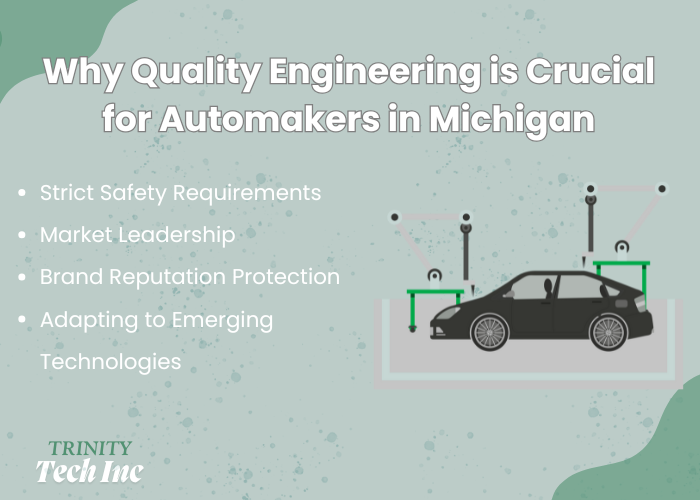
- Strict Safety Requirements: Consumer safety is of prime importance. Michigan manufacturers spend considerably on quality assurance to meet strict safety standards.
- Market Leadership: In a competition-based industry led by innovation, higher quality is what differentiates automakers. Quality containment services prevent defects from affecting production, helping companies maintain a strong market position.
- Brand Reputation Protection: One recall can ruin an automaker’s reputation. Quality engineers strive to keep recalls to a minimum while having high production efficiency.
- Adapting to Emerging Technologies: With the growth of electric vehicles (EVs) and autonomous driving technology, Michigan’s automotive sector is at the forefront of technological innovations. Quality engineers make sure these technologies meet performance and reliability criteria.
By placing emphasis on quality engineering, Michigan is further establishing itself as a world leader in the automotive sector.
Types of Quality Engineers
Within Michigan’s thriving automotive sector, quality engineering lies at the core of every step of manufacturing. From raw material to finished vehicles, meeting top standards is critical to safety, reliability, and performance. There are several varieties of quality engineers with various components of the process on which they specialize, all playing their roles in making Michigan an automotive giant.
Here’s a better look at the various kinds of quality engineers and how they make an impact:
- Manufacturing Quality Engineer – Oversees production processes, identifies defects, and implements solutions to maintain high-quality standards while improving efficiency.
- Supplier Quality Engineer (SQE) – Ensures raw materials and components from suppliers meet industry standards through audits, inspections, and quality assessments.
- Process Quality Engineer – Focuses on optimizing manufacturing workflows, reducing defects, and enhancing consistency in production.
- Product Quality Engineer – Conducts testing and inspections to ensure final products meet safety, durability, and performance requirements.
- Reliability Engineer – Analyzes failure rates and wear patterns to enhance the long-term performance and durability of automotive components.
- Software Quality Engineer – Ensures automotive software, autonomous systems, and embedded technologies function correctly and comply with safety regulations.
- Continuous Improvement Engineer – Implements lean manufacturing and Six Sigma strategies to refine processes, minimize defects, and drive ongoing quality improvements.
Educational Requirements for Quality Engineers
To become an automotive industry quality engineer, there is a need to have a solid technical background and possess specialized skills. Below are the most important educational qualifications:
Bachelor’s Degree – An engineering degree, such as Mechanical, Industrial, Manufacturing, Electrical, or Software Engineering, is normally necessary.
Certifications – Industry-specific certifications such as Six Sigma (Green Belt/Black Belt), Certified Quality Engineer (CQE), or ISO 9001 Certification add skills and job opportunities.
Technical Skills – Knowledge of quality management systems (QMS), statistical process control (SPC), and tools such as FMEA, GD&T, and root cause analysis is helpful.
Advanced Degrees (Optional) – A master’s degree in Quality Management, Engineering, or Business can assist in leadership positions and specialized areas such as reliability or process engineering.
Internships & Experience – Practical experience through internships, co-op programs, or industry-related projects is essential for developing practical skills.
Analytical skills, problem-solving skills, and industry standards knowledge enable quality engineers to perform well in Michigan’s competitive auto industry.
Conclusion
Quality engineering is a fundamental component of the process of making sure that products or services attain some quality standards. To ensure product quality across various different industries and uses, quality engineers have a vital function in detecting and resolving issues within the production process, improving business processes, and making sure that raw materials are utilized effectively. If you want to pursue a career in quality engineering, it is crucial to possess strong attention to detail, technical skills, and effective communication.