

Michigan has been the U.S automotive industry’s beating heart for many years. Its high concentration of manufacturers, suppliers, and logistics companies means it is no wonder automotive warehousing is so important to the region’s supply chain. For OEMs and tier suppliers, having the correct warehousing strategy can be the difference between business as usual and expensive production downtime.
What is Automotive Warehousing?
Automotive warehousing is specialized storage and management of raw materials, components, and finished products within the auto supply chain. It ranges from engine components and tires to electrical systems and body panels.
Automotive warehouses fulfill several roles:
- Inventory control for just-in-time (JIT) production
- Storage of important components for original equipment manufacturer (OEM) and aftermarket use
- Distribution centers for shipping to dealerships and retailers
- Cross-docking for reduced storage time and increased velocity
With the complexity and accuracy of contemporary manufacturing, effective warehousing is no longer a nicety—it’s a requirement.
Importance of Automotive Warehousing in Michigan
Michigan is exceptionally well-positioned to be an automotive powerhouse. Being home to industry giants Ford, General Motors, and Stellantis, it has an abundance of talent across the vehicle production cycle in every phase.
In the automotive sector, there is an enormous focus on efficiency and precision because of the expense of downtime on a production line. Any brief hold-up in the supply chain can result in considerable production stoppages, which equates to higher expenditure and customer dissatisfaction. Logistics solutions like warehousing and fulfillment services are thus a vital part of the contemporary automotive supply chain.
This is why auto warehousing in Michigan matters so much:
Geographic Strategic Advantage
- Central location in the Midwest with access to highways and interstates
- Close proximity to Canada, an important trade partner in automotive supply chains
- Port access, rail, and airport access for multi-modal logistics
Close proximity to Manufacturing Plants
- Shortens shipping time and transportation expense
- Improves responsiveness to shifting production requirements
- Supports just-in-sequence (JIS) delivery models
Skilled Workforce and Infrastructure
- Established legacy of automotive competence
- State-of-the-art infrastructure specifically designed to accommodate industrial warehousing and logistics
Through the use of sound automotive warehousing facilities in Michigan, manufacturers can optimize processes, reduce costs, and stay competitive.
Types of Automotive Warehousing Solutions
Automotive warehousing varies according to production needs, product categories, and business size. In Michigan, a variety of specialized warehousing options serve OEMs and suppliers:
Raw Material Storage
Used for the storage of critical materials such as steel, plastic, and aluminum, usually in climate-controlled facilities to maintain quality.
Component Warehousing
Specialized in managing and storing parts such as brakes, batteries, and electronics, designed to handle a large number of SKUs.
Finished Goods Warehousing
Stores finished vehicles or assemblies prior to shipping out, usually with loading docks for easy distribution.
Cross-Docking Facilities
Minimizes storage time by transferring incoming shipments directly into outbound transport, accommodating time-sensitive and just-in-time (JIT) operations.
Third-Party Logistics (3PL) Warehousing
Contracted warehousing operated by logistics providers, providing flexibility, cost savings, and added services such as kitting and packaging.
Most leading automotive warehousing companies in Michigan provide custom solutions to suit the requirements of OEMs, Tier 1, and Tier 2 suppliers.
Challenges and Solutions in Automotive Warehousing
Automotive warehousing is characterized by a variety of operational challenges that have the potential to interfere with supply chain efficiency unless well-managed. Luckily, with effective logistics strategies and supply chain principles, these problems can be efficiently addressed.
Main Challenges in Automotive Warehousing
- High SKU Volume: Warehouses have to handle thousands of parts, ranging from tiny bolts to massive engines, with little visual distinction.
- Inventory Accuracy: Anything less than perfect accuracy can cause production halts or expensive recalls.
- Timely Deliveries: Just-in-time (JIT) production demands accurate, on-time availability of parts.
- Spare Parts Complexity: Coordinating a vast inventory across warehouses, dealerships, and service centers makes fulfillment even more difficult.
Effective Solutions
To counter these challenges, car manufacturers and suppliers can adopt:
- Advanced Inventory Management Systems: Enhance tracking, minimize mis-picks, and keep real-time stock levels.
- Real-Time Tracking Technologies: Increase visibility and responsiveness throughout the supply chain.
- Demand Forecasting: Forecast inventory requirements and avoid stockouts or overstock.
- Centralized & Regional Distribution Centers: Optimize spare parts logistics and lower lead times.
- Automation and Analytics: Increase accuracy, speed, and decision-making through data-driven insights.
Key Features to Look for in a Michigan Automotive Warehouse
Choosing the right automotive warehouse involves more than just space—it’s about ensuring seamless operations, security, and industry compliance. Here are the key features that matter most:
Location and Accessibility
Being close to manufacturing centers and transportation routes allows for quicker turnaround times and lower freight costs.
Climate and Environmental Controls
Temperature and humidity control to precise levels is essential for maintaining sensitive materials such as electronics and chemical coatings.
Security Measures
Sophisticated surveillance and limited access systems protect high-value automotive inventory from theft or damage.
Technology Integration
Contemporary warehouses use WMS, RFID, and real-time tracking technology to maximize inventory accuracy and improve operations.
Scalability and Flexibility
Facilities must be designed to deal with variations in inventory quantity without affecting day-to-day operations.
Compliance and Certifications
Conformance to industry norms such as ISO 9001, IATF 16949, and OSHA affirms operational quality and customer trust.
Whether raw materials, components, or finished vehicles are stored, these amenities are a requirement for a hassle-free and secure warehousing system in Michigan.
Best Practices for Efficient Automotive Warehousing
To stay ahead in a competitive market, manufacturers must adopt warehousing best practices that boost efficiency and minimize waste.
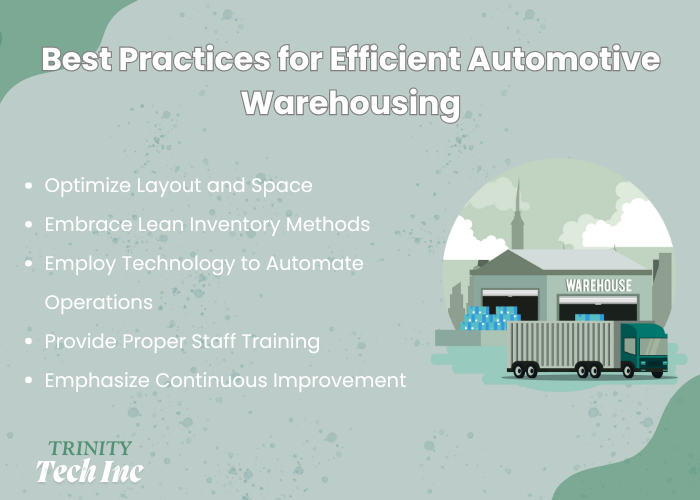
- Optimize Layout and Space: Utilize vertical storage and slotting efficiency to optimize space and enhance picking speed.
- Embrace Lean Inventory Methods: Incorporate just-in-time (JIT) and just-in-sequence (JIS) approaches to minimize excess inventory.
- Employ Technology to Automate Operations: Utilize a warehouse management system (WMS) coupled with ERP for real-time inventory management.
- Provide Proper Staff Training: Provide warehouse personnel with the capability to safely and efficiently use tools and systems.
- Emphasize Continuous Improvement: Monitor KPIs on a regular basis and incrementally adjust according to performance metrics and feedback.
These habits are adopted by Michigan’s top auto warehousing companies and can be implemented by manufacturers of any size to increase efficiency and reliability.
Conclusion
Automotive warehousing is a foundation of effective manufacturing, particularly in a high-demand state such as Michigan. From raw materials to end-of-line distribution, the correct warehousing solution can significantly boost your bottom line.
Through recognizing the types of warehousing solutions, essential characteristics, challenges, and best practices, manufacturers are able to make informed decisions that facilitate long-term growth.
If you are a manufacturer seeking dependable automotive warehousing services or searching for the best Auto parts storage solutions, Michigan provides a wide variety of options suited to the needs of the industry.
